Squadron 42 Guide — Gameplay, Systems, and Campaign Overview
Everything you need to know about Squadron 42 gameplay, systems, and campaign flow.
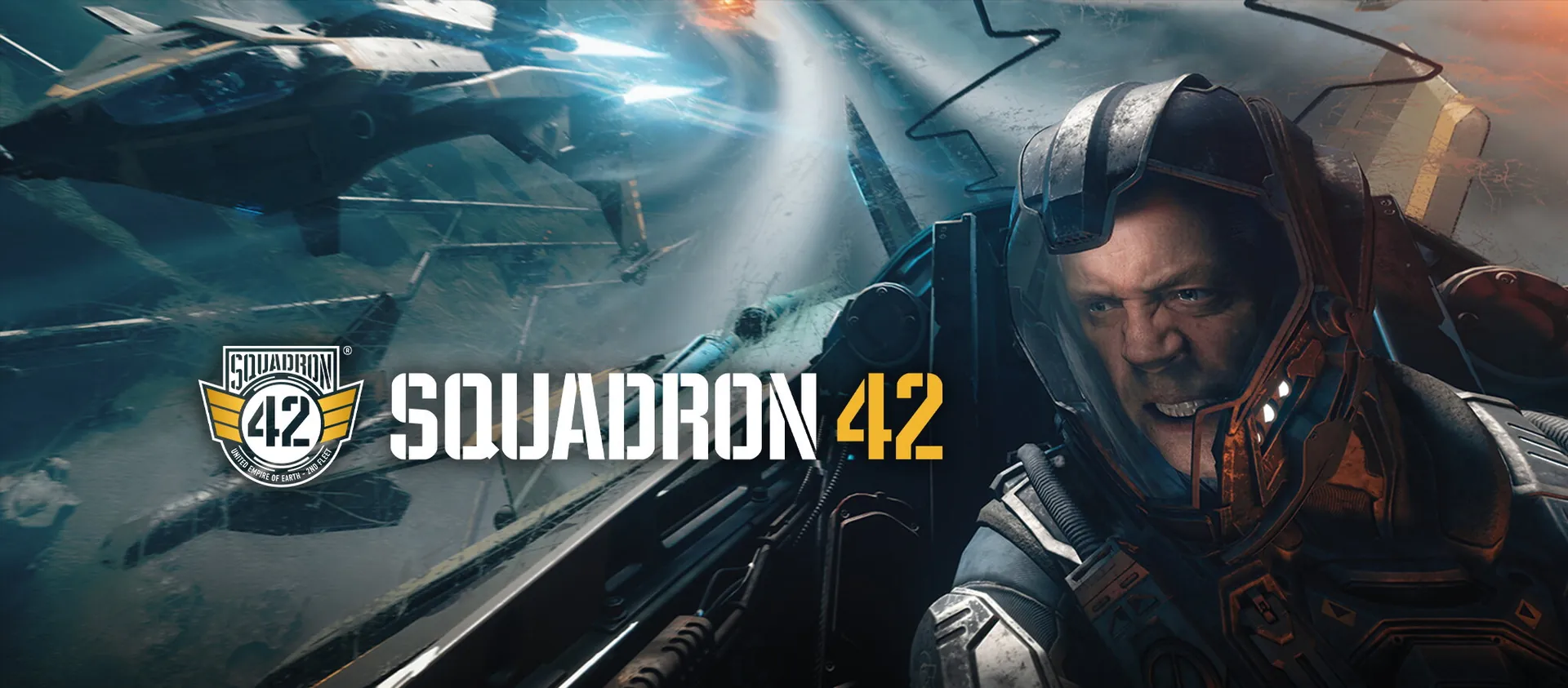
Squadron 42 is a cinematic single-player military space campaign developed by Cloud Imperium Games. Players enlist as rookie pilots in the United Empire of Earth (UEE) Navy during the 2945 Vega II conflict, serving aboard capital ships and flying fighters against the Vanduul alien empire. The campaign targets Q2 2027 on Windows PC.
Core Gameplay Overview
Squadron 42 blends four distinct gameplay styles into a seamless experience without loading screens:
- Space Flight and Combat \u2014 Piloting fighters like the Aegis Gladius in dogfights and fleet battles
- First-Person Shooter \u2014 On-foot boarding actions, station infiltration, and ground combat
- Capital Ship Life \u2014 Exploring ship interiors, interacting with crew, and managing downtime between sorties
- Zero-G EVA \u2014 Spacewalking between wreckage and navigating debris fields
The game runs on StarEngine, the same proprietary technology powering Star Citizen. All transitions between these modes happen in real time \u2014 you can walk from a carrier corridor directly into a fighter cockpit, launch into space, and land on a planetary surface without a single loading screen.
Space Flight and Combat
The flight model differs significantly from Star Citizen Persistent Universe. Squadron 42 removes the controversial Master Modes system entirely, using a unified flight model that scales ship speed from 0 to 1,200 m/s without toggling between navigation and combat states.
Quantum Travel
Quantum navigation requires no lengthy spooling. Players aim at a nav point, trigger Quantum Boost with a single button press, and engage the jump. During short jumps, pilots steer around quantum energy anomalies to avoid bubble collapse and hull damage. Quantum Boost allows ships to accelerate up to 5,400 m/s in local space while retaining pitch and yaw steering.
Power Management
Ship power distribution uses three streamlined presets accessible via hotkeys:
- Alt+1 \u2014 Aggressive (weapons boosted)
- Alt+2 \u2014 Balanced (even distribution)
- Alt+3 \u2014 Defensive (shields boosted)
Missiles are selected with dedicated number keys and fired once a lock is achieved. Countermeasures deploy instantly.
Ship Damage and Destruction
The proprietary Maelstrom physics system handles structural damage. Shots tear away armor plating piece by piece, hull sections break apart dynamically under fire, and ship components can be individually targeted. This applies to both your ship and enemy vessels \u2014 Vanduul fighters break into realistic wreckage rather than generic health-bar explosions.
First-Person Combat
Ground and boarding combat features snappier movement than Star Citizen server-bound gunplay. Key mechanics include:
- Sprint-sliding (Shift + C) to enter cover quickly
- Dynamic cover destruction \u2014 glass panels shatter, armor plates splinter, and barriers break under sustained fire
- Helmet removal \u2014 enemy helmets can be shot off
- Incapacitation and revival \u2014 downed enemies enter a wounded state; allies can revive them unless you finish them off
- Grenades and flanking \u2014 enemies actively use cover, coordinate flanking, and toss grenades when you remain stationary
The Navy Multi-Tool
Unlike Star Citizen's modular attachment system, Squadron 42 features an all-in-one military multi-tool with four integrated modes cycled via the B key:
- Tractor Beam \u2014 push, pull, and align environmental objects
- Cutter / Welder \u2014 slice through sealed hatches and access panels
- Energy Charge / Drain \u2014 manipulate power routing puzzles on derelict ships
- Material Processing \u2014 salvage and repair tasks
Life Aboard Capital Ships
Between combat sorties, players experience substantial narrative downtime aboard ships like the Idris-class frigate UEES Stanton. The frigate houses approximately 80 voiced crew members with active daily routines.
Downtime Activities
- Explore ship decks: Walk the mess hall, bridge, engineering bays, and flight deck
- Train at the gym: Run on treadmills and lift weights to boost stamina, endurance, and jump height
- Play arcade machines: Fully functional arcade cabinets with playable games
- Collect lore: Find hidden datapads, challenge coins, comic books, and model ships
- Access the Galactapedia: Use mobiGlas to read lore entries about the universe
- Interact with crew: Conversations adapt dynamically based on story milestones and player reputation
Armory and Loadout
Rather than manual item-by-item handoffs, players select mission loadouts from terminal screens, prompting the quartermaster to issue customized kits directly. Uniform terminals allow pilot suits, armor, and helmets to be color-customized.
Difficulty Settings
The game offers three core difficulty presets with independent sliders for flight and FPS combat:
| Difficulty | Flight Combat | FPS Combat | Target Player |
|---|---|---|---|
| Rookie | Reduced enemy aggression, higher survivability | Forgiving enemy accuracy and damage | Story-focused players |
| Wingman | Balanced enemy coordination, standard flight | Tactical AI flanking and grenade use | Standard baseline challenge |
| Ace | Aggressive pilot formations, rapid missile locks | High-precision fire, punishing damage | Demanding test of reflex and positioning |
Players can mix and match \u2014 for example, Ace difficulty for FPS combat paired with Rookie difficulty for flight.
Campaign Structure
The campaign spans 28 chapters and approximately 60-70 missions, organized as Episode One of a planned trilogy:
- Prologue: The Battle of Vega II aboard the Javelin destroyer UEES Gauntlet
- Character Creation: Woven into the story at BiotiCorp medical facility
- Life on the Idris: Free-roam tour aboard UEES Stanton
- Patrol and Derelict Recovery: Gladius patrol, Starfarer boarding, and Shubin Mining Station
- Escalating Operations: Increasingly complex fleet battles and ground assaults
A standard playthrough takes 40-45 hours, with completionist runs reaching 70 hours.
Frequently Asked Questions
Is Squadron 42 an open-world game?
No. Squadron 42 is a directed, linear campaign. While players have freedom to explore capital ships and choose tactical approaches during missions, progression follows an authored storyline.
Does Squadron 42 have multiplayer?
The core campaign is strictly single-player. Multiplayer space combat is available in Star Citizen's Persistent Universe and Arena Commander module.
Can I skip cutscenes?
Major narrative sequences cannot be skipped on a first playthrough. Certain repeated ambient animations, such as flight suit dressing, do provide a skip option after the initial view.
Related Guides
Squadron 42 Chapters — All 28 Chapters and Story Structure
Squadron 42 contains 28 chapters in Episode One. Explore the chapter structure, major story beats, and what happens in each phase of the campaign.
Squadron 42 Length — Campaign Hours, Chapters, and Playtime
Squadron 42 length is confirmed at 40-45 hours for the main story, up to 70 hours for completionists. Here is how the campaign playtime breaks down.
Squadron 42 Missions — Campaign Structure and Mission Types
Squadron 42 features roughly 30 missions across 28 chapters. Explore mission types, structure, and how the campaign unfolds from prologue to finale.
Squadron 42 Single Player: Offline Campaign Explained
Squadron 42 is a strictly single-player cinematic campaign. Here is what that means for offline play, co-op status, and multiplayer alternatives.